Posted on
How are your winter plans for shipping food-grade liquids going? If you don’t have a solid answer in mind, it might be time to start planning, even while it’s still summer.
The problem comes down to basic economics and the human tendency to deal with a problem only when it arises. By the time the end-of-year freeze rolls around, companies looking for finite heated shipping and transfer capacity often find themselves stuck.
In practice, failure to plan turns winter into a competition with other temperature-sensitive shippers. Heated handling capacity, storage space, transportation, and inventory support all become highly sought after and more expensive, provided they can be sourced at all. For many companies, the trouble hits during a seasonal uptick in business, when the operation is already stretched thin and has the least room to absorb a shipping problem.
How Cold Skews Shipping Demand at the End of the Year
Cold temperatures don’t create the same problem for everyone in your operation. It starts as a physical issue, changing the flow characteristics of the food-grade liquid you want to ship. On the dock, it becomes an operational issue. In the office, it becomes a drain on productivity. On your books, it appears as delay costs and avoidable premiums.
Thermal: Oils, glycerine, and lecithin that pump cleanly during summer can arrive too viscous to move through the same processes in winter. This is the fundamental problem that technologies such as low-pressure steam heating and dedicated heated storage exist to resolve; naturally, demand for those services rises when temperatures fall.
Procedural: That single physical change creates a chain of operational issues. Product has to be heated before it will transfer, so railcars and flexi-tanks sit longer. Transfers slow, residue remains in containers, and every load ties up more equipment and labor. Each complication must either be accounted for in the operating plan or managed on the spot.
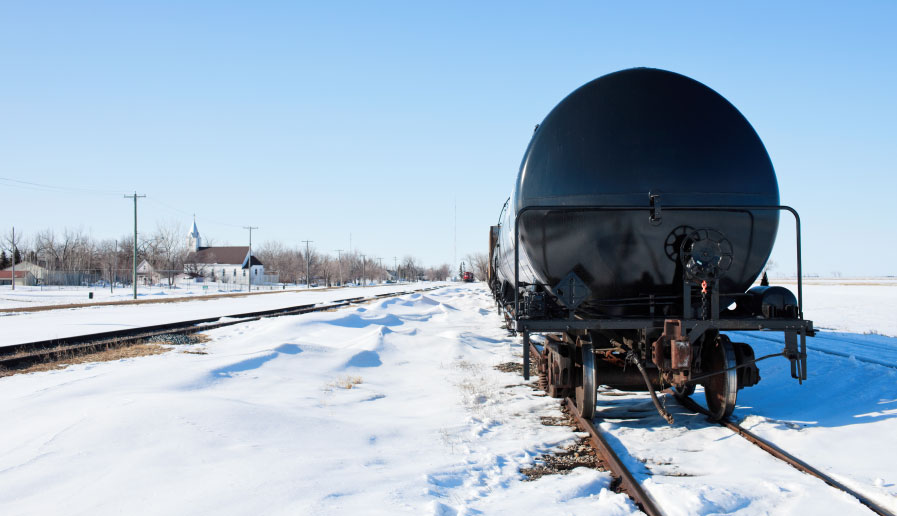
Business: Improvised handling has a cost. Railcars accrue demurrage, the federally regulated charge that starts once a car sits past its allotted free time, while product warms. Delivery windows slip, and loads paid for in full can arrive short when viscous product remains in the container. Short-notice heated capacity may also come at a significant premium compared with capacity booked in advance.
Across all three levels, there’s a common theme: waiting until winter makes the problems needlessly difficult or expensive, if not outright impossible, to solve. By the time product is thickening in a railcar, many decisions that could have prevented the problem have already been made.
Securing Heated Storage and Transfer Before the Winter Rush: A Primer
Confirm your 3PL can actually do all of it
Capabilities such as heated storage, low-pressure steam application, onsite rail access, and food-grade compliance aren’t a given. In July, learning that a new provider doesn’t offer one you critically need is a capability check. In November, it’s a pending disruption with no easy fix.
Mind transport and transloading schedules
Lead times stretch and carrier capacity tightens during winter. By that basic math, any schedules you set today are schedules you will be glad to have in place at the end of the year, when everyone else is scrambling for trucks and dock time.
Line up your transloading in advance as well, whether that means rail-to-truck transfer, flexi-tank discharge, or drum and tote filling. Those are the handoffs that bottleneck first when the weather turns.
Map out storage, heating, and arrival timing
Where does your product get stored? How does it get heated, and when does it actually need to arrive? The answers change by product. Coconut or palm oil that sets up nearly solid requires different handling than glycerine that only thickens, so part of the mapping process is knowing which method each product calls for: railside steam, a heated storage room, or heat maintained in transit.
From there, match your arrival schedule to how much product can be heated at once so you’re not staging three railcars against one boiler. Plan this in summer and you’re building around the weather instead of reacting to it.
Fully understand the heated capacity at your disposal
Total capacity is only part of the picture. Just as important is how much a provider can heat at once, including how many railcars can be steamed simultaneously. Get those figures and the provider’s actual availability in writing well ahead of the cold season.
If you know precisely how much space and coverage you will need, reserve against them. If not, estimate those requirements and secure the necessary data as early as possible.
How USA Warehousing Supports Winter-Ready Food-Grade Liquid Logistics
USA Warehousing gives shippers two ways to bring cold, viscous product back into a workable range. Low-pressure steam boilers apply heat directly to tanker railcars on the siding, while a dedicated heating facility of approximately 3,800 square feet allows flexi-tanks and other inbound bulk liquids to be brought to temperature before transfer. The right approach depends on the product, but the objective remains the same: prevent slow or stalled transfers from tying up containers, equipment, and labor.
Those heating capabilities are integrated with onsite rail access, food-grade handling, and a full range of bulk liquid services. Once product reaches the facility, USA Warehousing can heat it as needed and complete rail-to-truck transloading, flexi-tank discharge, or drum and tote filling without sending it to another location. Keeping those steps within one operation reduces handoffs when product is most vulnerable to temperature-related delays.
Ready to lock in heated storage and transfer capacity before the winter rush? Contact USA Warehousing to secure the heating, rail access, and food-grade handling capacity your bulk liquids need to keep moving through the cold season.