Posted on
Every transfer point in a liquid supply chain is either an opportunity for delay or an opportunity for efficiency.
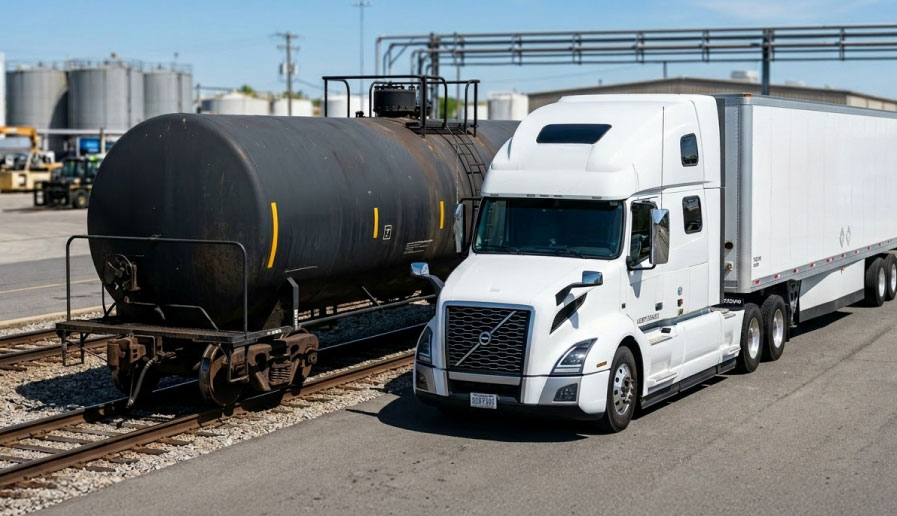
For shippers moving large volumes of food grade liquids, the transition from rail to truck is one of the most operationally significant points in the entire journey. It’s where timing, infrastructure, and handling capability all converge. When those elements are aligned, transfers happen quickly and product moves on schedule. When they aren’t, the consequences ripple across the rest of the supply chain.
Onsite rail access is one of the most effective ways to keep that transition running smoothly, and it’s a capability that’s often underweighted when businesses are evaluating 3PL partners.
Why Rail Matters for Bulk Liquid Logistics
Rail remains one of the most cost-effective and high-capacity modes of transport available for food grade liquids. Tanker cars can carry significantly more product per shipment than road tankers, making rail the preferred choice for moving large volumes over long distances.
However, rail also introduces a logistical handoff that requires careful coordination. Once a tanker car arrives, the clock starts. The time a car sits on track waiting to be unloaded comes with real costs, both in fees and in downstream delays. The faster and more efficiently product can be transloaded from rail to truck, the better the economics of the entire shipment.
The Problem with Offsite Rail Handling
When a 3PL facility doesn’t have onsite rail access, the process becomes more complicated than it needs to be.
Tanker cars arriving at a nearby rail yard need to be transloaded at a separate location before product can reach the warehouse or distribution point. That means coordinating an additional leg of transport, managing handoffs between different parties, and introducing more touchpoints where delays can occur. Each added step is another variable that can go wrong — a scheduling conflict, a capacity issue, a weather event — and the further product has to travel between rail and facility, the more exposed it is.
For food grade bulk liquids in particular, more touchpoints also mean more opportunities for handling errors and compliance risk. Maintaining product integrity across multiple transfer locations requires more documentation, oversight, and coordination than a single, integrated facility can provide.
How Onsite Rail Access Changes the Equation
Onsite rail access collapses the gap between arrival and transloading. When a tanker car pulls directly into a facility, the transloading process can begin immediately without intermediate transport, additional coordination, or waiting on a third party to become available.
The operational benefits are straightforward. Dwell time decreases because cars aren’t sitting idle while logistics are arranged. Product moves from rail to truck in a single, controlled environment where equipment, personnel, and compliance protocols are all in place. And because the entire transfer happens within one facility, the chain of custody stays intact and documentation is simpler to manage.
For shippers working with tight delivery windows or high-volume operations, those efficiencies aren’t marginal, they compound. Faster turns per railcar mean more throughput over the course of a season. Less dwell time means lower ancillary costs. Fewer handoffs mean fewer opportunities for something to go wrong.
The Role of Heating in Rail to Truck Transloading
Onsite rail access is a significant advantage, but it’s most effective when paired with the heating capabilities needed to handle viscosity-sensitive liquids.
Tanker cars carrying food grade oils, glycerine, lecithin, and similar materials are subject to temperature changes during transit. By the time a car arrives — particularly during colder months — product may have thickened considerably. Without the ability to apply heat directly to the railcar before pumping begins, unloading slows down, residue builds up in the car, and the risk of incomplete transfers increases.
Low-pressure steam heating applied directly to tanker cars on the rail siding keeps materials fluid and ready to transfer. Combined with onsite rail access, it means that from the moment a car arrives, the facility is equipped to handle it not just logistically, but physically. That combination is what separates a truly capable liquid transloading operation from one that can only handle product under ideal conditions.
How USA Warehousing Supports Rail to Truck Operations
USA Warehousing operates with onsite rail access and low-pressure steam heating systems designed specifically for liquid tanker car handling.
Tanker cars can be received and unloaded directly at our facility, with onsite steam boilers providing railside heating to keep product fluid and transloading efficient. Combined with our food grade compliance protocols and full range of bulk liquid handling services, we provide an integrated rail-to-truck operation that minimizes dwell time and keeps product moving on schedule.
For food grade liquid shippers evaluating 3PL partners in the Northeast, onsite rail capability is one of the most practical differentiators to look for and it’s one we’ve built our operation around.
Rail-to-truck transloading is a moment where supply chains either gain time or lose it. The infrastructure a 3PL has in place at that handoff point — rail access, heating capability, food grade compliance — determines which one it is. When those capabilities are integrated into a single facility, the transfer becomes one of the most reliable parts of the supply chain rather than one of the most uncertain.
Ready to streamline your rail-to-truck bulk liquid transloading? Contact USA Warehousing to learn how our onsite rail access and heated transloading capabilities can improve throughput and keep your supply chain on schedule.